
Multifunctional stethoscope
Multifunctional Stethoscope VS2
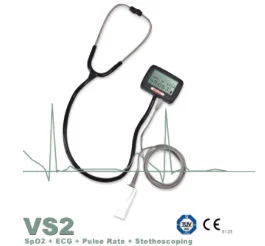
Description
- Compact and portable, easy to use
- Display of ECG, heart rate, SpO2, pulse rate, ECG waveform
- Adjustable screen contrast
- alarms for SpO2 and pulse rate above the maximum permissible values
- Low power consumption
- Main parameters
- Heart rate Measurement range: 30bpm ~ 300bpm, accuracy: ± 2 beats per minute or ± 2%
- SpO2 Measurement range: 0% ~ 100% (resolution 1%), accuracy:
- 70% ~ 100%: ± 2%, below 70% undefined
- Pulse rate measurement range: 30bpm ~ 250bpm, accuracy: ± 2 beats per minute or ± 2%
- Display: 2.7" backlit LCD display (resolution 160 x 96)
- Power consumption: ≤ 60 mA
- Voltage: DC 3.6 ~ 4.2 V
- Power supply: 3.7V lithium battery
- Battery life - about 20 hours when fully charged
Dimensions: 87mm (L) × 63 mm (W) x 19mm (H)
Weight: 180g
Standard configuration
1x Multifunctional stethoscope
1x external SPO2 Pulse Oximeter
1x User Manual
1x power adapter
1x USB charging cable
So far everything works without problems, both the pulse oximeter and the ECG.
Operation of the pulse oximeter
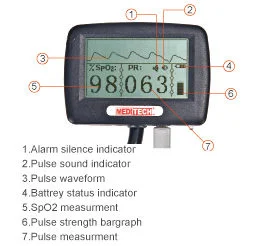
ECG Monitor Operation
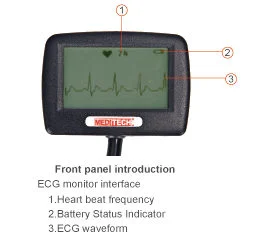
The only thing is that the ECG is noticeably affected by chest excursions during breathing (the baseline drifts), but overall everything displays fine.
The ECG is recorded from 3 contacts on the back side of the device (where the stethoscope diaphragm is). Before use, it is recommended to apply a small amount of conductive gel to the contacts.
Naturally, one can only judge the type of rhythm; the main waves are clearly distinguishable; there is no way to assess myocardial trophicity. Although it is interesting — maybe if the sensor is applied to different areas of the chest, could one obtain something similar to precordial leads (V1-V6)?
The stethoscope itself also works, it may be a bit quiet, but it is audible. But that is of course not its main function,