
Main components of the shock device
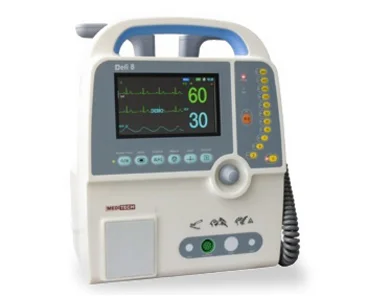
DC shock
Main components of the DC shock device:
The device consists of the following boards:
1. ECG board.
2. Charging and high voltage board.
3. Power supply board.
4. Processing boards.
5. Main board.
6. Display board.
7. Printing board.
And of:
Two electrodes (paddles): equipped with an insulated handle raised from the conductive surface so that no electric shock occurs to the device user, and also equipped with two switches for discharge and charge, and three indicator lights that indicate the quality of contact between the two electrodes and the skin surface (weak – medium – good), in addition to a pediatric paddles button that helps remove the adult shock surface to obtain a smaller surface for use on children.
2. ECG cable: for acquiring the heart signal.
3. Charging capacitor: it is the part responsible for providing the charge necessary for the shock to occur, its capacitance is 32 microfarads, maximum charge 6000 [V], maximum operating voltage 5200 [V].
4. Battery: it is one of the most important parts in the device, and it must be charged
-6-
permanently so that when the power is cut off it is ready for use and charged
because if it is not charged, it may lead to the death of the patient if he needs the device at that time, and it consists of six rechargeable batteries, each battery provides 2 [V].
Main control buttons of the device:
1. Power: device on button.
2. Selector switch: energy selector in joules, to set the required energy to charge the capacitor, and the energy ranges between (9-400) joules.
3. Charge: it is used to charge the capacitor.
4. Charge indicator light: an indicator that indicates that the capacitor has been charged and is ready for discharge, and it is located on the paddle and on the control panel.
5. Discharge: a button placed on the paddle, pressed at the same time with its counterpart on the second paddle in order to discharge the charge through the patient's chest.
6. Sync (Synchronizer): to synchronize the discharge of the charge with the ECG signal, specifically with the peak of the R threshold, where the discharge wave is applied after detecting the R wave and at its peak.
7. Alarm: gives an audible alarm according to the heart rate, and gives an alarm if the limits set by the doctor are exceeded, and this button is used to turn this sound on and off
9. ECG: to calibrate the length of the ECG signal relative to cm.
10. Freeze: freezes the ECG signal on the screen.
11. Run/Stop: used to start and stop the printer.
12. Mark: places a mark on the printer paper, from which it starts and records.
13. High: used to change the upper heart rate limits, which when exceeded the alarm sounds.
14. Low: used to change the lower heart rate limits, which when exceeded the alarm sounds.
16. battery charge indicator light: gives a light indicating the battery charging process.
17. paddle: used to acquire the ECG signal via the paddle.
Device alarms:
The device emits an audible alarm according to the user's setting of the heart rate. The device is pre-calibrated for the lower heart rate limit, which is 30 beat/minute, and the maximum heart rate, which is 150 beat/minute. If the patient's heart rate exceeds the two aforementioned limit values, it will emit an audible alarm, and the audible alarm indicator, which is in the shape of a bell, will appear on the screen.
-7-
How to use the shock device:
1. The electrodes are smeared with high-conductivity gel and the patient's skin is cleaned for two purposes:
* Reducing skin resistance to the minimum limits in order to reduce the energy lost through the skin I2R and raise the proportion of useful energy discharged through the heart muscle
** The lost energy is thermal energy, and its increase leads to skin burns
1. The energy to be delivered to the patient's heart is selected via the selector on the device interface.
3. Turn on the charge switch.
4. Press the two electrodes firmly on the patient's chest to obtain good contact and conduction that reduces resistance through the skin, as well as preventing unwanted movement due to the patient's reaction to the shock, and the discharge electrodes in the devices used carry an led that indicates the required pressure on the patient's chest.
5. Wait for the charging completion signal.
6. Discharge the charge by pressing the discharge handles located on the electrodes (handles), where the charge is discharged through the body whose resistance is around 50 ohms.
Device faults:
1- Battery fault.
2- Paddle fault.
3- Electronic faults.
4- Fault in the ECG signal cable.
5- Fault in one of the control buttons.
6- Fault in the main power supply.